Saturday, September 17, 2011

DRIVE - Movie Review


People often ask me why I hate action movies.

This is, of course, an impossible question. Impossible because it's based on an incorrect assumption. Because, while action movies very rarely make it onto my list of great films, I do still appreciate the genre. In fact, when done well, I downright love the genre. The problem is, when it comes to making action thrillers these day, it just doesn't seem as though they are trying very hard. Computer generated effects do not a great movie make. And the writer by committee approach to most studio action flicks gives a whole new meaning to the time honored phrase "too many cooks in the kitchen." Or maybe the simple fact is that most action directors these days simply just aren't very good.

From the opening frames of Nicolas Winding Refn's new potboiler, "Drive," we know that we've at least avoided that last pitfall.

Methodically and confidently building suspense not through showy effects, but through basic pacing and a sharp (note: not necessarily quick) editing, he announces his intentions early. He's going to tell us a story. He's not going to rush. He's not going to try to bowl us over what he can do with the camera. He's simply going to tell us a story. And he's going to tell it well.

As the 1980's infused pop score plays over the opening credits, we realize this film is throwback in more ways than one. Not simply an homage to Walter Hill's brilliant Ryan O'Neal starrer "The Driver," but a testiment to the crime thriller itself. In a way, this film's roots trace it's inspiration to an even earlier time, the film noir movement of the late 40's and 50's. A genre whose morally ambiguous leading men often found themselves roaming the streets trying to find a way out of a dilemna they themselves have created. Fighting a system they have no hope to actually conquer. In a seemingly inevitable race against time itself.

Like many of those brilliant early works of cinema, "Drive" takes place in the bright and guilty place itself, Los Angeles. But not the Los Angeles of glitterati and movie premieres. Instead, it dwells in the city's lower depths. The places where the bottom feeders and the broken dreamers nurse their afflictions of disappointment at the bottom of a bottle or in the arms of the closest warm body.

It's a Los Angeles, that many Angelenos know too well. For every Hollywood star, there are a thousand would-be's that just never quite made it. For every mansion, there are ten thousands hovels inhabited by those whose expectations have gone from fame and riches to simply trying to make it through the day.

Ryan Gosling's character, known simply as "Driver," exists in such a place. Possessing the natural gifts to take any NASCAR driver in a one-on-one race, he instead uses his talents to shepard around would-be criminals for five minute intervals at a time. Selling his services to the highest bidder, we can imagine a younger version of The Driver who might have one day had much more lofty dreams. As he picks up odd jobs as a stunt man on Hollywood movie sets, we imagine a world where he too could be the leading man instead of simply a human test dummy.

Gosling plays the character with such innate saddness that every small joy is reason for our hearts the cheer. The small smile which creases his face at the innocence of a child. The larger smile gained by the sight of that child's mother, Irene, played by Carey Mulligan (An Education, Never Let Me Go), continuing her streak of characters who, despite my best efforts, I can't help but to fall in love with by the end of their time on screen.

Of course, Irene is living with her own disappointments. A single mother still tethered to a husband in prison. Living in the same shabby dwelling as her Driver neighbor. She deserves a smile too. And for a moment, the two lonely hearts get to have their happiness.

But only for a moment. If these were lives where dreams came true, these two would hardly be living in the situation they are now. If this were a world with easy answers, we'd be living in a different movie. And thank goodness for those viewing this masterwork of tension, we are not.

Instead, Refn weaves a tangled web coiled with intracate characters and memorable moments.

I chuckled for a moment when I realized that under the two leads and a memorable Albert Brooks playing against type as a very bad man who coincidentally is also somewhat connected to the movies, that the cast was basically filled with television all-stars. Bryan Cranston, currently crafting one of TV's most memorable characters on "Breaking Bad" plays The Driver's agent to the underworld and closest friend. Christina Hendricks, the hourglass-figured Joan Holloway from AMC's other Emmy hoarder "Mad Men" plays a pivotal role. Even resurgent Ron Perlman from "Sons of Anarchy" gets to sink his teeth into a meaty role made-to-order. This excellent casts supports a terrific ensemble of leads in a film with simply too many good moments to mention.
Fair warning, it can be brutal. I had to avert my eyes on more than one occasion to avoid being splattered with blood. The Driver doesn't believe in guns. But he's very much at home with blunt force.

Yet unlike the carbon copy action films that role off the Hollywood assembly line, every death in this film comes with consequence. Both for the victim and victor. This is a film where life counts. And while there will naturally be certain moviegoers who simply enjoy the gore, a more refined viewer will see that this callous extinguishing of life is yet another layer of melancoly added to lives which already feel forgotten.

Bravo to Nicolas Winding Refn for crafting a film that not only satisfies the suspense junkie in all of us, but paints a complete portrait of complex characters living the best they can. These are people who already know that happily ever after isn't really an option for them. But to see the one you love smile back at you, even for just a moment, sometimes that's all you can ask for.

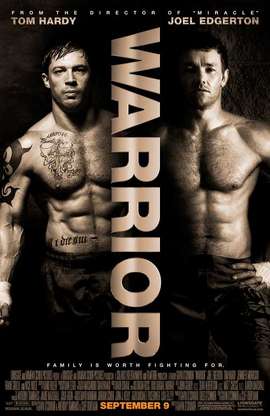
WARRIOR - Movie Review


It's one of the best kept secrets of good writing.

Sure, most stories come down to the battle between good and evil. The hero on the white horse dueling it out with the evil narcissist with the twirled mustache and a penchant for bad things. It's easy. The audience can always understand it. They know who to root for. With a well timed musical cue, they may even know when to root.
But, in real life, things are rarely so crystal clear. Life is lived in the grey areas and the distinction between black and white is hardly the wide gulf we were lead to believe. And our toughest decisions aren't the ones between a wrong and a right. They lie in deciding the greater good or the lesser of two evils. And this is where great stories come from.

While we know who we want to win between the capital G Good Guy and the capital B Bad Guy, try this scenario on for size. In Polish director Krzysztof Kieslowski's brilliant ten-part series, "The Decalogue," a doctor is presented with a quandry. A young wife comes to seek his expert advice. Her comatosed husband is under the doctor's care and the woman needs to know for sure whether he will live or die. The reason she needs to know with such immediacy is that she's just learned that she is pregnant. Her husband is not the father. Knowing what the news would do to her husband should he ever wake up, she considers an abortion. However, if he will never wake up, she will keep the baby. The doctor, a deeply religious man, is constrained between two hard choices. If he tells her the truth, that her husband will live, he is condemning the unborn child to death. However, saving the baby will require him to break another of the Ten Commandments by telling a lie. Which does he choose? You'll have to rent "The Decalogue" to find out.

In the new film "Warrior," from the director of "Miracle," Gavin O'Connor, the audience is faced with the opposite choice. The choice between the greater good. Like all sports movies, the film comes down to a battle between two teams. Or, in the case of a mixed martial arts movie, it's a battle between two individuals. Now for the catch. The two warriors are brothers.

Brendan Conlon, played with nice guy sincerity by Joel Edgerton, may have been an athlete in the past. But now on the wrong side of thirty, he teaches physics at a cheery suburban high school in Philadelphia.

His brother, Tommy Conlon, played by Tom Hardy is a recently returned war hero, budding alcoholic, and so filled with rage that one imagines, without life in the ring, he'd probably take out his frustrations on whoever passes him on the street.
Neither brother is a bad guy. And both's reasons for wanting to win the Sparta tournament (sort of like a MMA Super Bowl) are admirable. Brendan Conlon, a victim of a predatory bank loan and an unsympathetic school board is three weeks away from losing his house. Tommy feels he owes a greater debt, which I will not reveal here, but his need for the money is equally altruistic.

Tommy also draws a significant amount of rooting interest from the fact that he is a legitimate war hero. But as every punch deserves a solid counter punch, Brendan is nursing a serious case of parental neglect. Their alcoholic father, played with an appropriate sense of sadness by Nick Nolte, clearly has favored his super athlete son Tommy to the more reserved Brendan. And one can see Brendan's plight as equal parts providing for his loving family, while trying desperately to win the respect of his unloving father.

I'll admit. Watching the trailer for "Warrior," the too-cool-for-school side of me couldn't help raise the corny alarm. This is hardly a movie with much "indie" cred, despite low key cinematography by Masanobu Takayanagi. It's clearly a movie aimed squarely at playing your heart strings with a swelling musical score and characters so relatable that rooting against them would feel like rooting against our own family.
But, here's the thing. It worked. I found myself dabbing tears from my cheek on more than one occasion (shhh, don't tell anyone). And discovering that best kept secret, screenwriters Anthony Tambakis, Cliff Dorfman, and Gavin O'Connor, craft a compelling story where the audience has an impossible choice to make. Who do we want to win? What's the greater good.

Whichever hero you choose in the end, this film is definitely worth the price of admission. While the film doesn't necessarily break any new ground, it will break through your hardened emotional shell. Bring the tissues. Or, maybe just claim allergies when your date asks you about the droplets of water running from your eyes.

Tuesday, September 13, 2011

New Tumblr Blog


Have just added a new Tumblr companion blog. Check it out at...

http://christophermalcolm.tumblr.com/

Tuesday, August 30, 2011

NEW WEBSITE DESIGN!!!


IT'S ALIVE!!! Newly redesigned website online now. Check it out when you get a chance.

www.christophermalcolmphotography.com

Monday, June 13, 2011

Midnight in Paris - Film Review


Woody’s Back!!!!

For the last two decades, Woody Allen has been fighting a losing battle. Having set the comedic bar so high with films like “Annie Hall,” “Hannah and Her Sisters,” and “Manhattan,” he’d made himself something of a tough act to follow both from behind the camera and in front of it. The latter becoming a more and more difficult task as Woody behind the camera grew with age, and Woody in front of the camera just… aged. Suddenly, the nebbish scoundrel was no longer hilariously charming. As Woody grew older, the same character that at one time seemed charming was now, just sort of off-putting. Compound this with the uncomfortable nature of certain aspects of Woody’s real-life romantic affairs and it all combined to make the prospect of a Woody Allen romantic comedy suddenly far fetched. In recent years, he sought to address this problem by having different actors play their versions of Woody Allen. Larry David had a shot in “Whatever Works.” Anthony Hopkins and Josh Brolin both had their go in “You Will Meet A Tall Dark Stranger.” But while all of these actors have their talents, they are quite simply not Woody Allen.

Then comes Owen Wilson. One of the most talented comedy players in the last decade. His pugilist nose and wry smile seeming to belie a hilarious secret that only he knows. Graduated from broad comedies like “Wedding Crashers” and “Hall Pass,” he’s not the obvious choice for the Woody Allen surrogate. But, my oh my, was he the right one.

Watching “Midnight in Paris” brought back the joy of watching a Woody Allen movie that I hadn’t felt since “Deconstructing Harry.” The romance was back. The sharp dialogue and supporting characters were suddenly more alive. And the outlandish concept, a favorite of Woody Allen from films like “Sleeper” to “Zelig,” suddenly seemed less a stunt and more a perfectly sensible plot. And it was all tied together by a central performance by Owen Wilson.

How did he do this? How did the latest Woody Allen stand-in succeed where so many other talented actors had failed? Simple. He didn’t play Woody Allen. He played himself. Wilson’s character Gil may be spitting out Woodyisms left and right, but the being he inhabits is completely his own. Gil onscreen has far more in common with his lovable Roy O’Bannon character in “Shanghai Noon” than the fabled Alvy Singer of “Annie Hall.”

The distractions that accompany Woody Allen, both the real and fictional, melt away and are replaced by a protagonist we root for from reel one. We know that Inez, even if played by Rachel McAdams, is not the right woman for Gil. We can all relate to Gil’s wonderings of what his life would’ve been like if we were to have been born in a different era. We can all relate to Gil’s desire to follow his own dream, however impractical, despite pressures to take a more conventional course. And because of the delightful of Owen Wilson, we care about the outcome every step of the way.

I have no idea of knowing whether or not Woody Allen enjoyed working with Wilson as much as I enjoyed watching the results of their collaboration. But there’s a large part of me hoping that he too saw the possibilities. Just as Martin Scorsese seems to have been reinvigorated by what at first seemed an unlikely pairing with Leonardo DiCaprio, I can see a new string of work from Woody Allen with Mr. Wilson at the center. Not only can I see it, I’m hoping for it. After 43 years behind the camera, this film proves that Woody Allen has plenty to offer us yet. I can’t wait to see what’s next.

Friday, June 3, 2011

The Tree of Life - Review


Exactly what you make of Terrence Malick’s new film “The Tree of Life” is likely to depend on your own beliefs. The film’s expansive canvas covers (literally) everything from the big bang theory to the end of times all filtered through the experiences of a grieving family in small town Texas in the 1950s. But your interaction with the film will rely on more than simply your religious beliefs. I will depend on your belief in the power of cinema.

We are all weaned from an early age, whether consciously or subconsciously, on three-act structure. All our stories have a beginning, middle, and an end with various causes and effects laced in between. This is true from our early bedtime stories to the latest blockbuster. Does Terrence Malick believe in that? Well, not so much.

The enigmatic director behind just five films in the last 38 years has his own set of beliefs. He believes in cinema’s powers of observation. Sure his films have specific characters. And yes, they go through trials and tribulations. But his films never really seem to be about those trials and tribulations. Instead, they are a study of behavior. They are a study of environment, which allow us to draw our own conclusions.

The sheer enjoyment of a film like “The Tree of Life” is not in the wondering of what will happen next. Instead, the film’s power relies on what’s happening right now. The subtle look in a father’s eyes when he realizes his own dreams may go unrealized. The excitement of a young boy allowed his first up-close glance and a woman’s undergarment. A loving wife’s private torment when caught between her children and her husband. In a Malick picture, even the gentle way the tall grass floats from side-to-side is a reason for excitement.

Undoubtedly this picture will split opinions among theologians as to the meaning or validity of its events. But the sheer filmmaking brilliance cannot be denied. A director at the top of his game. A cast that strikes all the right notes. And an imaginary world fully formed. This is a great work of art, and one that should keep you thinking for years to come.

Thursday, June 2, 2011

Beginners - Film Review


Just saw a sneak preview of this film last week. In one word, brilliant. This is exactly why I go to the movies. Fantastic script. A director with an original vision. Spot-on performances. It touches on the entire realm of human emotion. A cast of people simply reaching out to make a connection, while the world, and more often themselves, stand in the way. And in an era of studios confusing CGI for quality, this refreshingly simple film reminds you that all you need for a great film is a camera and a great story.

You'll see a lot of your own parents (whether gay or straight) in the Christopher Plummer character, and Melanie Laurent continues to be simply magic every time her face hits the screen. This is the kind of movie where your cheeks may hurt at the end. I spent at least 90% of it with an involuntary grin on my face. Just marveling at the creativity on display. It's like an early Woody Allen movie when he didn't so much break the rules as make them up as he was going along. This is filmmaking at it's finest.

The film opens tomorrow, June 3rd. Rush to the theatre. Or, of course, add it to your queue. Either way, this film is not to be missed.