Showing posts with label film comment. Show all posts

Sunday, December 25, 2011

Steven Spielberg is not an edgy filmmaker.

In fact, he's the exact opposite. If you looked up the Hollywood style in the dictionary, you'd likely be shown a xerox copy of Mr. Spielberg's IMDB page.

Ever since defining the "blockbuster" with "Jaws," his own personal style has become the template against which big budget action films are judged. And he rarely misses a beat. I mean, how can you miss the mark when you are the mark, right?

Well, after a brief hiatus, Mr. Spielberg is back at it again. With two movies as a matter of fact. With "The Adventures of Tin Tin," he catches his colleague Robert Zemeckis' fever for CGI animation. And with the wonderful new work, "War Horse," he draws on all his experience and vast skill set to produce what Spielberg does best. Create a Spielberg movie.

Spielberg films to me always feel more like watching a moving storyboard than anything actually taking place in the real world. His characters leap forward from the screen as if drawn from comic books. If you watch it closely, even in Spielberg's Oscar winning "Schindler's List," you will see the same sweeping camera moves as you would in "E.T." or "Catch Me If You Can." And, as with all of his films, those sweeping crane shots float to the orchestral sounds of John Williams' sweeping scores.

"War Horse," the sweeping epic of one horse's journey during World War I Europe is perfectly suited for this approach. With it's sights set firmly on your heartstrings, the film doesn't pull any emotional punches. Told through episodic sequences, we follow the majestic horse and the lives of the humans who it comes into contact with. Set among vast English countrysides and massive battles, the film is oddly most effective when dealing in minutiae. The drama of an auction block. A fall harvest. The most efficient way to cut barbed wire. All these scenes work because we are fully invested in the lead character. Even if he does arrive on four legs.

"War Horse" is heroism in the face of great tragedy. Of beauty in a time of horror. You won't leave the theater thinking you've seen the reinvention of the wheel. But by the time Spielberg lays his late "Gone With The Wind" inspired final shot on you, you will find yourself wishing you had a war horse of your own. And your heart will once again be warmed over.

Saturday, December 24, 2011

THE GIRL WITH THE DRAGON TATTOO (David Fincher Version) - Film Review

Did the 2009 Swedish classic "The Girl With The Dragon Tattoo" really need to be remade?

No.

The brilliant tension of the original has hardly had a chance to grow stale in the whopping TWO whole years since it's initial release. Aside from a few small changes, the story hasn't changed much as laid out in the late Stieg Larsson's smash hit novel "Men Who Hate Women" (retitled for the film release). And even the presence of one of my favorite directors David Fincher is hardly enough to justify remaking an already exemplary movie trilogy just because of American's inexplicable reluctance to read subtitles.

I don't think I'm overstating things when I say that the character of Lisbeth Salander (here played by Rooney Mara but originated on screen by Noomi Rapace) is one of the most dynamic creations in recent literary history. Pint-sized in stature, she appears superhuman in her ability and ferocity. A goth hacker with a punk-rock hairdo who's never met a match she can't defeat, or an evil she can't out-duel. Okay, that's oversimplifying a bit. Actually, it's oversimplifying a lot.

You see, what makes the Salander character so interesting is not that she's invincible. It's that she only appears to be invincible.

Beneath the tattoos and piercings is a wounded girl. Some of the details of her wounds are better explained in later chapters of the trilogy and won't be discussed here. But the bravado is on display from the word go. The dark eye liner. The black leather. The snarl. Every minute of her existence is geared toward signaling to the world that she isn't to be messed with.

But what lies beneath that is a woman has been deeply messed with. A woman with a deep distrust of people, she instead keeps them at a distance. A woman so hurt be past relationships that, instead of misplacing her love, she decides rather not to give it at all.

So why let down her guard for Mikael Blomkvist (Daniel Craig)? The weathered news reporter is coming off the public embarrassment of trying to tell the truth about someone wealthy enough to change what the truth is. Hired by a wealthy Henrik Vanger (Christopher Plummer) to investigate a family so maladjusted as to achieve Shakespearean proportions, Mikael first engages Lisbeth as a research assistant. She's the best. He should know. She was the one they hired to investigate him.

The suspense that follows is just the icy scales of the story, while it's heart rests in the relationship between Mikael and Lisbeth and how each perceive exactly what that relationship is.

It's impossible to review this new film without comparing it to the old one. Since there's very little fundamentally different about this film other than it's clearly superior budget, the main point of conversation lies on the slender shoulders of... you guessed it, Lisbeth Salander.

Trying to replace Noomi Rapace as Lisbeth Salander is like trying to replace Vivien Leigh in a remake of "Gone With The Wind" (I only use that as an example Hollywood. Please DO NOT remake "Gone With The Wind."). Rapace so fully embodied Salander that it's really hard to imagine another actress ever playing the role. Miss Mara does an admirable job. However, where Miss Rapace seemed to BE Lisbeth Salander, I never shook the sense that Miss Mara was simply PLAYING Lisbeth Salander. And there's a lot to play with. The tough exterior. The wounded interior. The tattoo. Like Scarlet O'Hara, the role of Lisbeth Salander is pure gold. I think the difference between their two performances lies in the fundamental differences between Hollywood movies and those made in the rest of the world. The depth is there in both, it's just that the rest of the world is a little more comfortable burying things a bit deeper.

Rapace's Salander is a constant enigma. I know it sounds strange, but she's almost not human. More like a feral animal. Unpredictable. You have no idea what she'll do next. And she never telegraphs her motivations. When the original Salander climbs into bed with someone, you get the sense that she is asserting her power. She screws, she doesn't make love. Making love would be too personal.

When this Salander makes love, there is a kindness to it. When she meets a woman in a nightclub, there is almost a shyness to the initial encounter. Later, when taking a man into her bed, it directly follows seeing a picture of him as a happy couple, signaling to the audience that what she really wants is love.

Oddly, this may be true. For both versions of Salander. She's built up this unpenetrable persona to push the world away. But on the inside, all she really wants is for someone to pierce the shield. The difference between the two films is that Rapace's Salander would never be caught dead letting on to that fact. Whereas Mara's Salander projects an inner warmth just waiting to be uncovered.

It will be interesting to see what happens with this new series. The original trilogy, as good as it was, did trail off over the course of three films, with the third being the weakest (not coincidentally it's also the one with the least amount of screen time for the actual Girl With The Dragon Tattoo). Here, David Fincher has more openly introduced a possible emotional arc for the character of Lisbeth Salander that could potentially span the three films. While I would call a match up between the two versions of the first chapter a draw that slightly leans towards the Swedish version, I think Fincher's team has a chance to perhaps make a more effective complete trilogy. An extended epilogue in this film not present in the original, sets up a nice narrative conflict for coming episodes. And as much as I may dislike remakes, I'll definitely be on board for part two. Or, part five. Not exactly sure how to say that.

Saturday, October 8, 2011

Film Review - The Ides of March


If you could win an Academy Award for a combination of performances, this would be Ryan Gosling's year.

In the last month he's played such a wide array of convincing characters that one can't help but to wonder which man Ryan Gosling really is. Is he the strong silent type as he plays so effectively in the brilliant noir thriller "Drive?" Or is he the womanizing loveable cad with a gift for gab he portrays opposite Steve Carrell in "Crazy Stupid Love?" Or, is he something in between.

That might describe the character Gosling plays in his latest masterstroke as the ambitious Stephen Myers in the George Clooney directed political drama "The Ides of March." Stephen isn't the verbose ladies man on the prowl. But he's got enough charm to talk the world's most beautiful intern, Molly Stearns (played by Evan Rachel Wood) into bed. He's a man of few words, like his character in "Drive." And like that character, when he speaks, it's with a distinct purpose. In this case that purpose is to get his candidate elected president of the United States. He's dedicated to his job, and dedicated to his candidate Mike Morris (George Clooney in a thankless role). He's proud of saying that he's a veteran of more political campaigns than most will see in a lifetime. But even the pre-jaded Stephen Myers can't help but fall a little in love with this Democratic wet dream who, not so coincidentally, bears a striking resemblance to Obama circa 2008. Temperament and policy wise, of course. Physically, not so much. But, in case you miss the connection, production designer Sharon Seymour drives home the point with the same kind of pop-art Hope (or in this case Believe) posters that drove Obama's first campaign. Yet, the question remains, can we believe? And, despite the references, this film is by no means a condemnation of the current administration. or any administration for that matter. Instead, the question on Clooney's mind behind the camera seems to be, can we believe in the integrity of anyone? And if we do, is it even possible for any candidate to make it to the White House with that integrity intact? And, if we can't, then what are we all fighting for? Is the object of politics to help the people? Or to get elected?

Far too big a question of course to be answered by one movie. Instead, Clooney chooses to focus on the moral crisis faced by one man. And he wisely chooses to have that man played by Ryan Gosling.

Anyone who's seen "The Notebook" (and yes, that includes you, even though I won't make you admit it out loud) knows that Ryan Gosling is bursting with charisma. He has "It." Whatever "It" is. He holds your attention on screen. Like coming across a tiger in an alleyway. You can't turn away because you want to know what he's going to do next.

But Gosling, like his director and co-star Clooney, has made a career out of harnessing that charisma into characters who are greater parts substance than show. We can see in the way he carries himself that he IS a hardened campaign manager. But we can also see as the story goes along that a bit of that idealist that drove him into politics in the first place still remains. The moral question at the heart of the film is whether or not the two can co-exist.

You'll have to watch the film to find out. Like every element of life circa 2011, you're reaction may be slightly tinged red or blue by your personal politics. But you hardly have to be a bleeding heart liberal to enjoy the film. We've all wondered whether or not idealism can survive the coarse reality of life. If you haven't wondered about that, you're either the sweetest idealist in the history of the world. Or, you're already so jaded that you may just have a future in politics.

Saturday, September 17, 2011

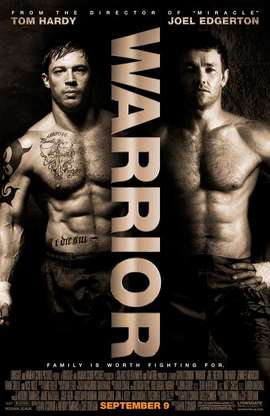
WARRIOR - Movie Review


It's one of the best kept secrets of good writing.

Sure, most stories come down to the battle between good and evil. The hero on the white horse dueling it out with the evil narcissist with the twirled mustache and a penchant for bad things. It's easy. The audience can always understand it. They know who to root for. With a well timed musical cue, they may even know when to root.
But, in real life, things are rarely so crystal clear. Life is lived in the grey areas and the distinction between black and white is hardly the wide gulf we were lead to believe. And our toughest decisions aren't the ones between a wrong and a right. They lie in deciding the greater good or the lesser of two evils. And this is where great stories come from.

While we know who we want to win between the capital G Good Guy and the capital B Bad Guy, try this scenario on for size. In Polish director Krzysztof Kieslowski's brilliant ten-part series, "The Decalogue," a doctor is presented with a quandry. A young wife comes to seek his expert advice. Her comatosed husband is under the doctor's care and the woman needs to know for sure whether he will live or die. The reason she needs to know with such immediacy is that she's just learned that she is pregnant. Her husband is not the father. Knowing what the news would do to her husband should he ever wake up, she considers an abortion. However, if he will never wake up, she will keep the baby. The doctor, a deeply religious man, is constrained between two hard choices. If he tells her the truth, that her husband will live, he is condemning the unborn child to death. However, saving the baby will require him to break another of the Ten Commandments by telling a lie. Which does he choose? You'll have to rent "The Decalogue" to find out.

In the new film "Warrior," from the director of "Miracle," Gavin O'Connor, the audience is faced with the opposite choice. The choice between the greater good. Like all sports movies, the film comes down to a battle between two teams. Or, in the case of a mixed martial arts movie, it's a battle between two individuals. Now for the catch. The two warriors are brothers.

Brendan Conlon, played with nice guy sincerity by Joel Edgerton, may have been an athlete in the past. But now on the wrong side of thirty, he teaches physics at a cheery suburban high school in Philadelphia.

His brother, Tommy Conlon, played by Tom Hardy is a recently returned war hero, budding alcoholic, and so filled with rage that one imagines, without life in the ring, he'd probably take out his frustrations on whoever passes him on the street.
Neither brother is a bad guy. And both's reasons for wanting to win the Sparta tournament (sort of like a MMA Super Bowl) are admirable. Brendan Conlon, a victim of a predatory bank loan and an unsympathetic school board is three weeks away from losing his house. Tommy feels he owes a greater debt, which I will not reveal here, but his need for the money is equally altruistic.

Tommy also draws a significant amount of rooting interest from the fact that he is a legitimate war hero. But as every punch deserves a solid counter punch, Brendan is nursing a serious case of parental neglect. Their alcoholic father, played with an appropriate sense of sadness by Nick Nolte, clearly has favored his super athlete son Tommy to the more reserved Brendan. And one can see Brendan's plight as equal parts providing for his loving family, while trying desperately to win the respect of his unloving father.

I'll admit. Watching the trailer for "Warrior," the too-cool-for-school side of me couldn't help raise the corny alarm. This is hardly a movie with much "indie" cred, despite low key cinematography by Masanobu Takayanagi. It's clearly a movie aimed squarely at playing your heart strings with a swelling musical score and characters so relatable that rooting against them would feel like rooting against our own family.
But, here's the thing. It worked. I found myself dabbing tears from my cheek on more than one occasion (shhh, don't tell anyone). And discovering that best kept secret, screenwriters Anthony Tambakis, Cliff Dorfman, and Gavin O'Connor, craft a compelling story where the audience has an impossible choice to make. Who do we want to win? What's the greater good.

Whichever hero you choose in the end, this film is definitely worth the price of admission. While the film doesn't necessarily break any new ground, it will break through your hardened emotional shell. Bring the tissues. Or, maybe just claim allergies when your date asks you about the droplets of water running from your eyes.