Showing posts with label hollywood. Show all posts

Sunday, December 25, 2011

Steven Spielberg is not an edgy filmmaker.

In fact, he's the exact opposite. If you looked up the Hollywood style in the dictionary, you'd likely be shown a xerox copy of Mr. Spielberg's IMDB page.

Ever since defining the "blockbuster" with "Jaws," his own personal style has become the template against which big budget action films are judged. And he rarely misses a beat. I mean, how can you miss the mark when you are the mark, right?

Well, after a brief hiatus, Mr. Spielberg is back at it again. With two movies as a matter of fact. With "The Adventures of Tin Tin," he catches his colleague Robert Zemeckis' fever for CGI animation. And with the wonderful new work, "War Horse," he draws on all his experience and vast skill set to produce what Spielberg does best. Create a Spielberg movie.

Spielberg films to me always feel more like watching a moving storyboard than anything actually taking place in the real world. His characters leap forward from the screen as if drawn from comic books. If you watch it closely, even in Spielberg's Oscar winning "Schindler's List," you will see the same sweeping camera moves as you would in "E.T." or "Catch Me If You Can." And, as with all of his films, those sweeping crane shots float to the orchestral sounds of John Williams' sweeping scores.

"War Horse," the sweeping epic of one horse's journey during World War I Europe is perfectly suited for this approach. With it's sights set firmly on your heartstrings, the film doesn't pull any emotional punches. Told through episodic sequences, we follow the majestic horse and the lives of the humans who it comes into contact with. Set among vast English countrysides and massive battles, the film is oddly most effective when dealing in minutiae. The drama of an auction block. A fall harvest. The most efficient way to cut barbed wire. All these scenes work because we are fully invested in the lead character. Even if he does arrive on four legs.

"War Horse" is heroism in the face of great tragedy. Of beauty in a time of horror. You won't leave the theater thinking you've seen the reinvention of the wheel. But by the time Spielberg lays his late "Gone With The Wind" inspired final shot on you, you will find yourself wishing you had a war horse of your own. And your heart will once again be warmed over.

Saturday, December 24, 2011

THE GIRL WITH THE DRAGON TATTOO (David Fincher Version) - Film Review

Did the 2009 Swedish classic "The Girl With The Dragon Tattoo" really need to be remade?

No.

The brilliant tension of the original has hardly had a chance to grow stale in the whopping TWO whole years since it's initial release. Aside from a few small changes, the story hasn't changed much as laid out in the late Stieg Larsson's smash hit novel "Men Who Hate Women" (retitled for the film release). And even the presence of one of my favorite directors David Fincher is hardly enough to justify remaking an already exemplary movie trilogy just because of American's inexplicable reluctance to read subtitles.

I don't think I'm overstating things when I say that the character of Lisbeth Salander (here played by Rooney Mara but originated on screen by Noomi Rapace) is one of the most dynamic creations in recent literary history. Pint-sized in stature, she appears superhuman in her ability and ferocity. A goth hacker with a punk-rock hairdo who's never met a match she can't defeat, or an evil she can't out-duel. Okay, that's oversimplifying a bit. Actually, it's oversimplifying a lot.

You see, what makes the Salander character so interesting is not that she's invincible. It's that she only appears to be invincible.

Beneath the tattoos and piercings is a wounded girl. Some of the details of her wounds are better explained in later chapters of the trilogy and won't be discussed here. But the bravado is on display from the word go. The dark eye liner. The black leather. The snarl. Every minute of her existence is geared toward signaling to the world that she isn't to be messed with.

But what lies beneath that is a woman has been deeply messed with. A woman with a deep distrust of people, she instead keeps them at a distance. A woman so hurt be past relationships that, instead of misplacing her love, she decides rather not to give it at all.

So why let down her guard for Mikael Blomkvist (Daniel Craig)? The weathered news reporter is coming off the public embarrassment of trying to tell the truth about someone wealthy enough to change what the truth is. Hired by a wealthy Henrik Vanger (Christopher Plummer) to investigate a family so maladjusted as to achieve Shakespearean proportions, Mikael first engages Lisbeth as a research assistant. She's the best. He should know. She was the one they hired to investigate him.

The suspense that follows is just the icy scales of the story, while it's heart rests in the relationship between Mikael and Lisbeth and how each perceive exactly what that relationship is.

It's impossible to review this new film without comparing it to the old one. Since there's very little fundamentally different about this film other than it's clearly superior budget, the main point of conversation lies on the slender shoulders of... you guessed it, Lisbeth Salander.

Trying to replace Noomi Rapace as Lisbeth Salander is like trying to replace Vivien Leigh in a remake of "Gone With The Wind" (I only use that as an example Hollywood. Please DO NOT remake "Gone With The Wind."). Rapace so fully embodied Salander that it's really hard to imagine another actress ever playing the role. Miss Mara does an admirable job. However, where Miss Rapace seemed to BE Lisbeth Salander, I never shook the sense that Miss Mara was simply PLAYING Lisbeth Salander. And there's a lot to play with. The tough exterior. The wounded interior. The tattoo. Like Scarlet O'Hara, the role of Lisbeth Salander is pure gold. I think the difference between their two performances lies in the fundamental differences between Hollywood movies and those made in the rest of the world. The depth is there in both, it's just that the rest of the world is a little more comfortable burying things a bit deeper.

Rapace's Salander is a constant enigma. I know it sounds strange, but she's almost not human. More like a feral animal. Unpredictable. You have no idea what she'll do next. And she never telegraphs her motivations. When the original Salander climbs into bed with someone, you get the sense that she is asserting her power. She screws, she doesn't make love. Making love would be too personal.

When this Salander makes love, there is a kindness to it. When she meets a woman in a nightclub, there is almost a shyness to the initial encounter. Later, when taking a man into her bed, it directly follows seeing a picture of him as a happy couple, signaling to the audience that what she really wants is love.

Oddly, this may be true. For both versions of Salander. She's built up this unpenetrable persona to push the world away. But on the inside, all she really wants is for someone to pierce the shield. The difference between the two films is that Rapace's Salander would never be caught dead letting on to that fact. Whereas Mara's Salander projects an inner warmth just waiting to be uncovered.

It will be interesting to see what happens with this new series. The original trilogy, as good as it was, did trail off over the course of three films, with the third being the weakest (not coincidentally it's also the one with the least amount of screen time for the actual Girl With The Dragon Tattoo). Here, David Fincher has more openly introduced a possible emotional arc for the character of Lisbeth Salander that could potentially span the three films. While I would call a match up between the two versions of the first chapter a draw that slightly leans towards the Swedish version, I think Fincher's team has a chance to perhaps make a more effective complete trilogy. An extended epilogue in this film not present in the original, sets up a nice narrative conflict for coming episodes. And as much as I may dislike remakes, I'll definitely be on board for part two. Or, part five. Not exactly sure how to say that.

Sunday, December 4, 2011

SHAME - Film Review

There's nothing inherently wrong with pornography.

There, I said it. A little kinkiness every now and then never hurt anybody. Unless, of course, you're into that. Human beings are naturally curious. We're also, naturally sexual. So when you put those two things together, it's only natural that we should be curious about each others sexuality. That's a good thing.

But it is possible to have too much of a good thing.

Like alcohol, pornography has a way of sucking you in. You take one sip, you feel fine. You take two, even better. Pretty soon, you find yourself wanting more and more. Then needing more and more. Even long after you've forgotten how it even tastes, you find yourself using it out of habit.

And as with any narcotic, once you get used to a certain thing, you find yourself needing to find harder and harder drugs to keep the same high. Pretty soon, the pornography you started with just doesn't do the trick anymore. So you have to keep looking for different outlets. Different stimulus. You suddenly find yourself turning to images and fantasies you may never have even dreamt of just to get back to normal. Pretty soon, this sexual narcotic has taken an effect on your life. No, you're not likely to find yourself shaking in the corner without your daily dose, but it can have an affect on your relationships and how you see the world. And if you're not careful, there may be no turning back.

Such is the case with Brandon Sullivan (Michael Fassbender), a Manhattan suit who's so deep into pornography that his work computer is for a time confiscated for being "filthy."

As a side note, I've always considered that to be the true sign of addiction to porn. If you can't get through the work day without a little taste, it may be time to get help. Oh, and how good must he be at his job that this isn't a fire-able offense?

But I digress. The fact is that Michael's entire life could be termed "filthy." When not surfing the naughty web, he fills his days and nights with frivolous sexual encounters. Even though one of the perks of looking like Michael Fassbender is that those encounters are plentiful, he still can never seem to get enough. Like a hungry child, trying to stuff his face with sweets in an effort to get full, he's missing the main ingredient, sustenance. He's got the quantity, but not the quality. And that's how he likes it. Like the impersonal skin flicks which he uses for his arousal, Michael sees sex as a carnal expression devoid of emotion. His longest "relationship" has been four months. From what we see, most of his sexual encounters don't last more than four minutes. Just enough time to serve the purpose.

It be easy from that description to draw that Michael was a truly despicable guy. But if we look deeper, we understand the reasons for his erotic dependence. A fear of intimacy. Like an alcoholic tossing back shots to dull the pain, Michael sees sex as an emotional antibiotic. These brief sexual trysts are in fact the only vacation he has from the pain of simply being him. Sex with emotion robs him of that safety zone. Love is too close for him. Love means pain. So when people threaten to get too close to his heart, he pushes them away.

At least he tries to. But some people just can't take a hint. That includes Sissy Sullivan (a once again terrific Carey Mulligan), Michael's sister who appears in town to throw his life into chaos. Not that it wasn't chaotic before, but her sheer existence seems to make him angry. The cool and collected Michael is a raging bundle of emotions around his sister. When his sleaze of a boss, David Fisher (James Badge Dale) makes a play for Sissy, Michael can barely contain himself. In excess of brotherly protection, Michael's resentment from seeing Sissy with another man seems to run deeper. While it is never known for sure, we suspect that Michael's relationship with Sissy may be at the root of his intimacy issues. When she climbs into his bed at night to snuggle, his discomfort is palpable. When she stands before him bare in the shower, one can't help but wonder what is going through his mind. And in Carey Mulligan's affecting performance, we suspect that the same thing may be running through her mind as well. At times, it seems as if the adventurous black sheep is almost baiting him. As if she knows the effect she has on him and is constantly searching for more. Sissy has a way of using love to salve her own wounds. And Michael's affection seems to be the medication she seeks the most.

Have Michael and Sissy ever been intimate? We don't know. But her effect on him is undeniable.

So is the effect of this film. I suspect that at least half of the audience members at the screening I attended were sick to their stomachs by the time the story ended. They, no doubt, saw the film as just another cheap exploitation of taboo. It made them uncomfortable, and they no doubt resented it.

But if you look deeper, you'll see the beauty in the film, and especially Michael Fassbender's performance. It is a character study of addiction. A man who seems so in control, but all the time is spinning out of it. We understand the root cause, even if we don't know the exact details. And director Steve McQueen, definitely one to watch, allows us to linger inside Michael's emotions. Through mostly a combination of brilliantly chosen one-shots, he allows us to contemplate Michael's inner turmoil. Michael's actions are not those of a pervert. They are the actions of an addict. A man filled with pain who tries to cure himself in the best way he can. But will the very cure lead to his own destruction?

Saturday, October 22, 2011

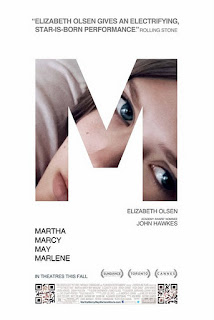
Film Review - Martha Marcy May Marlene


The difference between a good movie and a great movie is often the same as the difference between a good and bad relationship. Attention to detail.

From the opening frames of the wonderful new film "Martha Marcy May Marlene," it's the attention to detail that lets us know that we're in for something special.

Case in point. There's a scene midway through the film where Martha (alternatively known as Marcy May or Marlene), overhears a conversation between her stiff but patient older sister Lucy, played by Sarah Paulson, and her new, increasingly less patient husband Ted, played by Hugh Dancy. The mysterious Martha has just reappeared after a two year absense. What the couple doesn't know, and the audience only learns piecemail through a series of flashbacks is that she's spent this lost two years living on a commune in upstate New York as the willing captor or a menacing patriarch Patrick, played by the brilliant John Hawkes (more on him later). The happenings of the commune more than explan her behavior (well, most of it) but, at the moment, all the charming but frustrated Ted can think about is how do I get her out of my house. As the couple bickers in the other room, the eavesdropping Martha turns away as if to block out the sound. Sounds fairly straight forward, right? But here's where the detail kicks in.
Rather than simply giving us a standard shot of the tear streaming down her face as she wails audibly over the sounds of soarin harps, instead director Sean Durkin, making his feature film debut, allows us only a narrow angle of her face. Enough to read the emotion. Not enough to make it the same cookie cutter shot we've seen a thousand times. When the tear gently emerges from the corner of her eye, it's perfectly placed. As is the back of the couch where Martha lies. Just in frame enough to obscure our view and add interest to the frame.

It is with this level of attenton with which Durkin and his cinematographer Jody Lee Lipes infuse every frame of this film. It's also a level of detail demands from the film's performers.

Most of the attention for this film's success will undoubtedly be focused on the elfin titular character, played with aplomb by Elizabeth Olsen. Yes, that last name does sound familiar for a reason. In fact, we should probably just go ahead and get it out of the way up front. Yes, she IS related to the Olsen twins. No, she is not actually an Olsen twin. Instead she's the 22 year old younger sister of the "Full House" twins turned media magnets, which I imagine is both a blessing and a curse. Surely, being related to billionaires doesn't hurt your chances of meeting the right people on your path to Hollywood. However, it surely takes a little doing before people start to recognize you on your own and not just as Mary Kate and Ashley's little sister.

After this film, I don't suspect she'll have that problem for very long.

Seeing Miss Olsen's performance in the movie is nothing short of a revelation. She may share her sisters' high cheek bones and large beautiful Joan Blondell-style saucer eyes. But Olsen Part Three puts her gawkers to work as a canvas for emotion. She's able to convey feelings without the use of words. Love. Jealousy. Anger. Fear. All role out of her without having to roll her tongue. When she does speak, it's with a natural cadence which lends her character and situation added authenticity. Combined with excellent direction, photography, and production design by Chad Keith (who helped give 2008's excellent "Goodbye Solo" such a lived in feel), she makes you feel as if you're in a real place. That's what makes the events of the film feel so harrowing. They are so absolutely plausible.

If this is your first time seeing Miss Olsen, I can guarentee you it won't be the last. This is the kind of star is born movie that Hollywood was made for. I liken it to when Scarlett Johansen burst onto the scene after "Lost In Translation." You knew you were watching something special and that the next few years of your life would be filled with trips to the movies to see an endless string of movies featuring this new discovery. The last time I felt that was with Jennifer Lawrence in last year's "Winter's Bone." A young actress, built for stardom, standing opposite... that's right, John Hawkes. I don't know if he has some kind of gift for launching careers or not, but, if I were a young actress in Hollywood, I'd be begging my agent to get me any role he can opposite this man.

He is simply brilliant. In this film, sure. But apparently in everything. His portrayal of Teardrop in the previously mentioned "Winter's Bone" was one of the best I've seen in years. I won't have a Kanye West moment and declare that he should've won the Oscar when I don't even remember who did win, but I will say... No, really, he should've won the Oscar.

But I will make this bold prediction. He will win one of those pesky little golden men in the next five years.

Whether it's brilliant comedy like 2005's "Me and You and Everyone We Know," a brilliant western like HBO's "Deadwood," or a dark brooding drama like "Martha Marcy May Marlene," Hawkes slips into his roles with ease. And that's no small feat. I have actually had the pleasure of meeting John Hawkes and he's far from being a mountain of a man. Yet as Teardrop, and again here a Patrick, he has a way of portraying intimidating characters who, let's face it, scare the living bejesus out of you. And what makes his character so affecting here is that he does so much of his violence without a shred of force. Patrick operates much the same as pimp might. He seduces his young followers by making them feel special. He slips in an off hand comment to a still naive Martha early in the film about her father's neglect. Now, we never see her father and have no way of knowing if he was in fact neglectful, but he's so smooth in his delivery that the audience has to wonder. Worse yet, Martha begins to wonder. It's not a far jump for her to then begin wondering if everyone in her life has been neglectful. So when this delicate predator starts showing interest in her, she's putty in his hands. And because the character has been placed in the loving care of an actor like John Hawkes, we in the audience are as well.

When strolling through IMDB in preparation to write this review, I was struck by the sheer novelty of most of those involved. This is director Sean Durkin's first feature film. Cinematographer Jody Lee Lipes' bio reads as mostly a series of short films. And the diminutive lead, though an add-on in several of her more famous twin sisters' movies for the tween sect, has nothing on her resume suggesting she could carry such a deep and intricate film as this. Like their stellar lead, I expect everyone involved to get a major career boost from this. In fact, I wouldn't be surprised if their agent haven't already booked them for the next three years on the buzz for this movie alone. All I know is when they do, I'll be the first one in the ticket line.

Wonderful film. A must see. And, for heaven's sake, someone please give John Hawkes an Oscar already.

Saturday, September 17, 2011

DRIVE - Movie Review


People often ask me why I hate action movies.

This is, of course, an impossible question. Impossible because it's based on an incorrect assumption. Because, while action movies very rarely make it onto my list of great films, I do still appreciate the genre. In fact, when done well, I downright love the genre. The problem is, when it comes to making action thrillers these day, it just doesn't seem as though they are trying very hard. Computer generated effects do not a great movie make. And the writer by committee approach to most studio action flicks gives a whole new meaning to the time honored phrase "too many cooks in the kitchen." Or maybe the simple fact is that most action directors these days simply just aren't very good.

From the opening frames of Nicolas Winding Refn's new potboiler, "Drive," we know that we've at least avoided that last pitfall.

Methodically and confidently building suspense not through showy effects, but through basic pacing and a sharp (note: not necessarily quick) editing, he announces his intentions early. He's going to tell us a story. He's not going to rush. He's not going to try to bowl us over what he can do with the camera. He's simply going to tell us a story. And he's going to tell it well.

As the 1980's infused pop score plays over the opening credits, we realize this film is throwback in more ways than one. Not simply an homage to Walter Hill's brilliant Ryan O'Neal starrer "The Driver," but a testiment to the crime thriller itself. In a way, this film's roots trace it's inspiration to an even earlier time, the film noir movement of the late 40's and 50's. A genre whose morally ambiguous leading men often found themselves roaming the streets trying to find a way out of a dilemna they themselves have created. Fighting a system they have no hope to actually conquer. In a seemingly inevitable race against time itself.

Like many of those brilliant early works of cinema, "Drive" takes place in the bright and guilty place itself, Los Angeles. But not the Los Angeles of glitterati and movie premieres. Instead, it dwells in the city's lower depths. The places where the bottom feeders and the broken dreamers nurse their afflictions of disappointment at the bottom of a bottle or in the arms of the closest warm body.

It's a Los Angeles, that many Angelenos know too well. For every Hollywood star, there are a thousand would-be's that just never quite made it. For every mansion, there are ten thousands hovels inhabited by those whose expectations have gone from fame and riches to simply trying to make it through the day.

Ryan Gosling's character, known simply as "Driver," exists in such a place. Possessing the natural gifts to take any NASCAR driver in a one-on-one race, he instead uses his talents to shepard around would-be criminals for five minute intervals at a time. Selling his services to the highest bidder, we can imagine a younger version of The Driver who might have one day had much more lofty dreams. As he picks up odd jobs as a stunt man on Hollywood movie sets, we imagine a world where he too could be the leading man instead of simply a human test dummy.

Gosling plays the character with such innate saddness that every small joy is reason for our hearts the cheer. The small smile which creases his face at the innocence of a child. The larger smile gained by the sight of that child's mother, Irene, played by Carey Mulligan (An Education, Never Let Me Go), continuing her streak of characters who, despite my best efforts, I can't help but to fall in love with by the end of their time on screen.

Of course, Irene is living with her own disappointments. A single mother still tethered to a husband in prison. Living in the same shabby dwelling as her Driver neighbor. She deserves a smile too. And for a moment, the two lonely hearts get to have their happiness.

But only for a moment. If these were lives where dreams came true, these two would hardly be living in the situation they are now. If this were a world with easy answers, we'd be living in a different movie. And thank goodness for those viewing this masterwork of tension, we are not.

Instead, Refn weaves a tangled web coiled with intracate characters and memorable moments.

I chuckled for a moment when I realized that under the two leads and a memorable Albert Brooks playing against type as a very bad man who coincidentally is also somewhat connected to the movies, that the cast was basically filled with television all-stars. Bryan Cranston, currently crafting one of TV's most memorable characters on "Breaking Bad" plays The Driver's agent to the underworld and closest friend. Christina Hendricks, the hourglass-figured Joan Holloway from AMC's other Emmy hoarder "Mad Men" plays a pivotal role. Even resurgent Ron Perlman from "Sons of Anarchy" gets to sink his teeth into a meaty role made-to-order. This excellent casts supports a terrific ensemble of leads in a film with simply too many good moments to mention.
Fair warning, it can be brutal. I had to avert my eyes on more than one occasion to avoid being splattered with blood. The Driver doesn't believe in guns. But he's very much at home with blunt force.

Yet unlike the carbon copy action films that role off the Hollywood assembly line, every death in this film comes with consequence. Both for the victim and victor. This is a film where life counts. And while there will naturally be certain moviegoers who simply enjoy the gore, a more refined viewer will see that this callous extinguishing of life is yet another layer of melancoly added to lives which already feel forgotten.

Bravo to Nicolas Winding Refn for crafting a film that not only satisfies the suspense junkie in all of us, but paints a complete portrait of complex characters living the best they can. These are people who already know that happily ever after isn't really an option for them. But to see the one you love smile back at you, even for just a moment, sometimes that's all you can ask for.